


Not all burnout looks the same. Sensory burnout is a lesser known term.
People are most familiar with occupational burnout. This happens when a person feels exhausted and overwhelmed from too much workload or unrealistic expectations from an employer. It can affect energy, mood, work performance, and relationships outside of work. It’s definitely not nothing, and shouldn’t be ignored.
Occupational burnout can be addressed by taking time off, taking a vacation, or working to improve work-life balance by reducing hours.
Sensory burnout often shows up in subtle, confusing ways. Especially for adults who are used to pushing through. Sensory differences may not be recognized. A person has only experienced the world around them through their own nervous system. How would they automatically know their experience was vastly different from that of others?
Unlike occupational burnout, it might not be immediately obvious to you or those around you what is causing your burnout. This can be extremely frustrating for all involved. And unlike occupational burnout, taking time off for a vacation is not going to address the root cause of your struggle.
Sensory burnout can be more intense and last longer. It can require a substantial increase in self-awareness in order to learn and implement accommodations in your day to day life.
Here are some signs that your burnout may be sensory burnout:
Table of Contents
Toggle1. You Feel Exhausted by "Normal" Environments
Places that never used to bother you (stores, workplaces, social gatherings) now feel unbearable. Even minor outings like walking a few blocks to your mailbox or dropping your kids off at school can leave you depleted.
2. Rest Doesn't Fully Restore You
Sleep helps, but it doesn’t fix the exhaustion. Time off feels good briefly, then the crash returns as soon as you go back to your usual pace of life. It can feel like you could sleep for a month and still wake up depleted.
3. You're More Irritable, Numb, or Shutdown
Instead of feeling sad, you may feel flat, detached, or easily overwhelmed. Emotional regulation becomes harder which can be frustrating and confusing for you and those closest to you. You might think things like, “What is wrong with me?” and “Why can’t I just be happy?”. Your friends and family might be put off by your “grouchiness” and assume they did something wrong or you don’t care about them anymore. But that couldn’t be further from the truth!

4. You Avoid Tasks You Used to Handle
This is often mistaken for laziness. For some reason the thought of doing the dishes or taking the garbage out feels so heavy that it may as well be impossible. In reality, your nervous system may be avoiding sensory strain, not the task itself.
5. Your Tolerance Has Shrunk
Noise feels louder. Light feels harsher. Small disruptions feel bigger. By the time you’re grocery card is full and you’re waiting in line for check-out, your nervous system is setting off a million alarm bells. You can’t wait to get the heck out of there! It’s the reaction of a system that’s already maxed out.
6. You Crash After "Holding It Together"
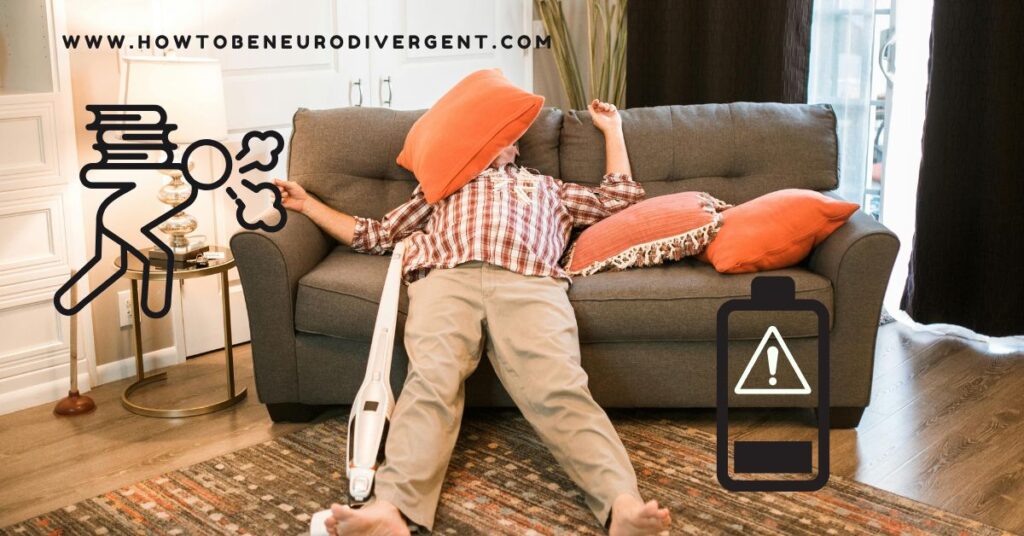
You may function during the day and completely collapse in the evening. Sensory burnout often includes delayed nervous system responses. You can get home from an “average” day at work and fall asleep sitting up on the sofa before it even gets dark. If you don’t know it’s sensory burnout causing your exhaustion, this can cause a lot of worry. You might be thinking, “How can everyone else go to work and still have the energy to go out to dinner and do an active hobby in the evenings? There must be something terribly wrong with me.”
Sensory Burnout Vs. Depression or Laziness
Sensory burnout is frequently misdiagnosed by professionals (and by ourselves!).
Here’s a helpful reframe:
- Laziness assumes a lack of effort. People might be frustrated with your lack of participation in social gatherings, errands, or household chores.
- Depression often includes hopelessness or loss of interest. Although, sensory burnout might not initially come with depression, it’s plain to see how sensory burnout can easily lead to it!
- Sensory burnout involves nervous system overload and reduced capacity. Your system’s inability to tolerate everyday experiences leaves you feeling like you are living life on “low-battery” mode no matter what you do. Things that used to be easy for you feel completely out of reach.
You may want to do things. You may still care deeply. You just don’t have the sensory bandwidth you once did. That distinction matters.
The problem comes when you try to treat sensory burnout as if you’re treating depression. Getting out, doing more, being more social, taking up a new hobby. All things that can be beneficial in the long run, but can make sensory burnout significantly worse. It can make you wonder why you’re doing “everything right” to get better, and things continue to spiral downward.
Why Pushing Through Makes Sensory Burnout Worse
Many late-diagnosed adults respond to burnout by trying harder:
- More discipline
- More structure
- More “self-care” that doesn’t actually reduce sensory overload
But sensory burnout isn’t solved by optimization. It’s eased though awareness, accommodation, and permission to stop overriding your system. You absolutely need to stop, or your body will do it for you. Pushing through sensory burnout can have severe long-term effects on your life.
Until the sensory strain is addressed, recovery stays out of reach.
The Role of Sensory Awareness in Recovery
Recovery from sensory burnout begins with understanding what’s actually draining you.
Sensory awareness allows you to:
- Identify high-impact stressors
- Catch overload earlier
- Reduce cumulative sensory strain
- Build supports that fit your nervous system
You want to be able to build a life that allows you to engage with the world in a sustainable way.
You're Not Broken. You're Overloaded.
For many late-diagnosed ADHD and autistic adults, discovering sensory burnout brings both grief and relief.
Grief for how long you struggled without support. Relief that there’s finally an explanation that makes sense.
You are not lazy.
You are not failing.
Your nervous system is asking for something different.
You may not be able to return to the pace and structure of the life you had before. But if you’ve been pushing through for a long time, it was never a sustainable option for you in the first place. Listening to that message is not giving up. It’s learning how to survive and live well.
Want Ongoing Support for Neurodivergent Burnout Recovery?
If you’re navigating sensory burnout, late diagnosis, or nervous system exhaustion, you don’t have to do it alone.
Join the How to Be ND newsletter for:
- Practical insights for late-diagnosed ADHD & autistic adults
- Education on sensory burnout, masking, and recovery
- Gentle tools that honor your real capacity
👇Sign up below and let this be a space where your experience is understood.
If you enjoyed this post, you might like this one 👉Nervous System Regulation: What Late-Diagnosed Autistic & ADHD Adults Need to Know
Thanks for listening, friends.

Disclaimer:
This post reflects my personal experiences and perspectives as a late-identified neurodivergent adult. While I aim to share helpful insights, I don’t speak on behalf of the entire ADHD or autistic community. Neurodivergence is diverse and individual—please interpret this content through the lens of your own needs and experiences. This article is not a substitute for professional or medical advice.