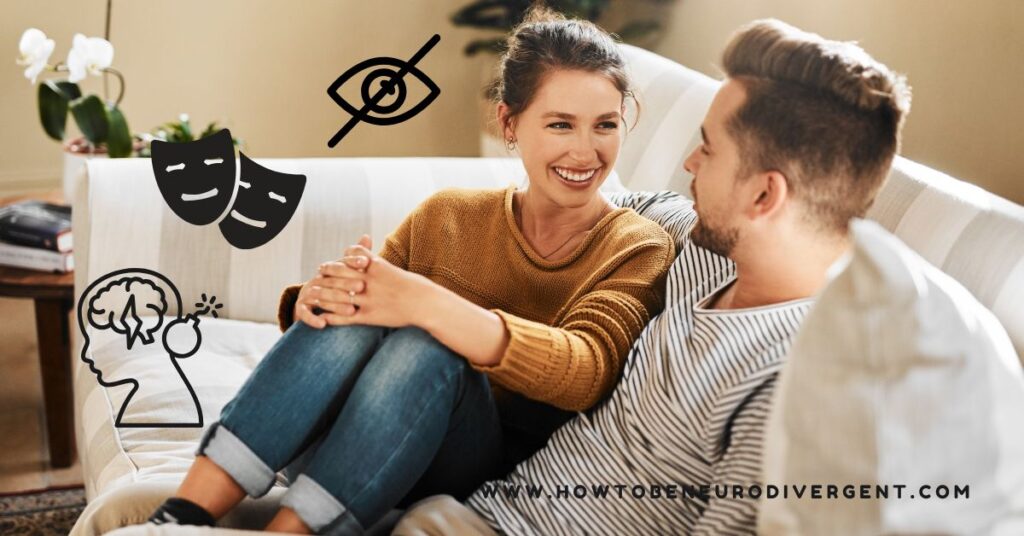


If being in a relationship feels exhausting (even when you care deeply about the other person) you’re not imagining it.
For many late-diagnosed autistic and ADHD adults, masking in relationships becomes so normal that it’s hard to tell where connection ends and self-erasure begins.
You may look “high functioning,” accommodating, or east to love on the outside… while quietly shrinking parts of yourself to keep the relationship stable.
This post explores masking in relationships for autistic and ADHD adults, why it’s a common realization after late diagnosis, and how self-compassion can help you move toward relationships where you don’t have to disappear to be loved.
Table of Contents
ToggleWhat is Masking in Relationships?
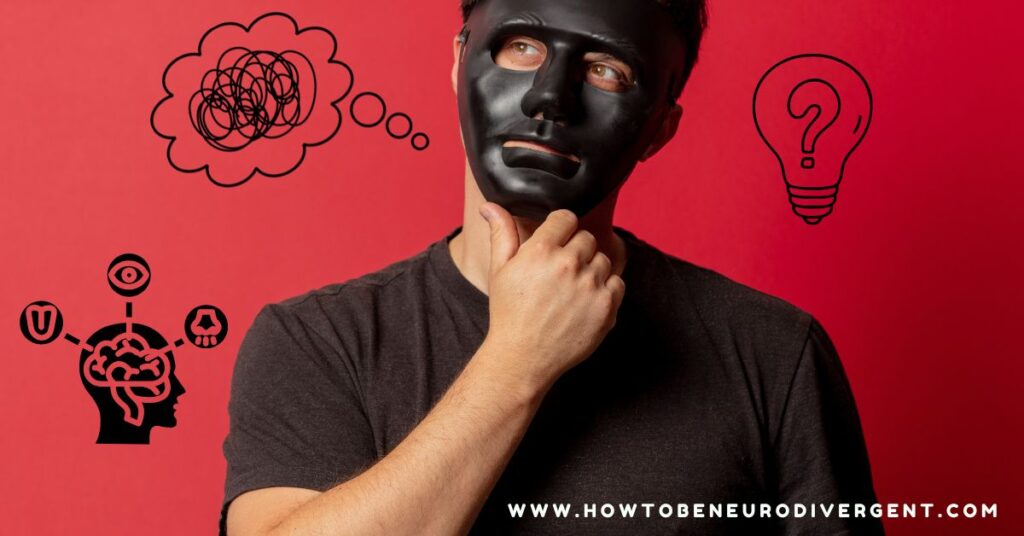
Masking is the process of suppressing or hiding your natural neurodivergent traits in order to meet external expectations.
When we talk about masking in relationships, this often includes:
- Monitoring your tone, facial expressions, or body language
- Forcing eye contact or emotional responses
- Hiding sensory needs or overwhelm
- Agreeing when you’re uncomfortable to avoid conflict
- Minimizing your needs so the relationship feels “easier” to the other person
Masking in relationships is about a survival response while seeking connection.

Why Masking in Relationships Is So Common for Late-Diagnosed Adults
Masking in relationships for autistic and ADHD adults rarely starts in adulthood.
It’s usually learned early and reinforced over time.
1. Love Was Conditional Growing Up
Many late-diagnosed adults learned that acceptance depended on being:
- Pleasant
- Low-maintenance
- Emotionally convenient
- Not “too much”
Masking became the price of belonging.
2. You Didn't Know Your Needs Were Valid
Without a diagnosis, many autistic and ADHD adults internalize the idea that their needs are personal flaws.
So instead of advocating for support, they adapt. Silently.
3. Fear of Rejection Runs Deep
Late diagnosis often comes with a long history of misunderstanding, rejection, or being told you were difficult.
Masking in relationships can feel like the safest way to avoid abandonment.
What Masking in Relationships Can Look Like Day to Day
Masking in relationships doesn’t always look dramatic.
Often it’s subtle.
You might:
- Feel responsible for everyone’s emotional comfort
- Say yes when your body says no
- Hide meltdowns or shutdowns
- Feel anxious before spending time together
- Need significant alone time to recover after connection
From the outside, the relationship may look healthy. On the inside, you may feel depleted. Or invisible.
The Emotional Cost of Masking in Relationships
Masking in relationships for autistic and ADHD adults comes at a real cost.
Over time, it can lead to:
- Burnout
- Resentment
- Loss of identity
- Increased shutdown or meltdowns
- A sense that love requires constant effort
One of the most painful realizations many late-diagnosed adults have is this:
“They love the version of me that works the hardest.”
That realization can be heartbreaking. And clarifying.
Masking is Not the Same as Compromise
Healthy relationships involve compromise.
Masking is different.
Compromise is mutual and flexible. Masking is one-sided and survival-basedd.
If you are consistently the one adjusting, accommodating, and disappearing, that’s burnout waiting to happen.
Self-Compassion When You Realize You've Been Masking
Many late-diagnosed adults feel grief or shame when they recognize how much they’ve masked in relationships.
You may think:
“Why didn’t I speak up?” “Why did I allow this?”
Self-compassion means remembering what you didn’t know at the time.
You used the tools you had to stay connected.
That deserves understanding.
Moving Toward Relationships Where You Don't Have to Disappear
Unmasking in relationships doesn’t happen all at once.
And it doesn’t require oversharing or confrontation.
It starts with safety.
1. Notice Where You're Holding Your Breath
Your body often knows before your mind does.
Pay attention to:
- Tension before conversations
- Relief when you’re alone
- Exhaustion after social time
These can be helpful data points.
2. Experiment With Small Truths
Your don’t have to try to unmask everything at once.
Start with small, low-risk honesty:
- Naming a sensory need
- Asking for a pause
- Saying no without over-explaining or apologizing
See how the relationship responds.
3. Communicate Needs Without Apology
Your needs are not inconveniences.
You can say:
“This is how my nervous system works.”
You don’t need to justify your existence to be worthy of care.
Love Should Not Require You to Disappear
Masking in relationships for autistic and ADHD adults is understandable. Especially after a lifetime of being misunderstood.
But love that requires self-ereasure is not sustainable.
Healthy relationships make room for your full humanity:
- Your needs
- Your limits
- Your neurodivergence
You are not too much
You are allowed to take up space.
A Gentle Invitation
At howtobeneurodivergent.com, we believe real connection begins where masking ends. If this post resonated with you, you’re learning what safety and authenticity can look like together.
I believe it’s important to feel a sense of connection, community, and support while learning to adapt after a late-diagnosis.
That’s why I created How to Be ND, my twice-monthly newsletter.
It’s a slow, thoughtful space for neurodivergent adults. Inside you’ll find gentle reflections, practical support, and reminders that you’re not broken. You’re learning how to live with clarity and self-trust.
If you’d like those notes to land in your inbox a couple of times a month (no noise, no pressure, no fixing), I’d love to have you join us.
👇Sign up for How to Be ND and let’s keep figuring this out together.
If you enjoyed this post, you might like this one 👉Neurodivergent Communication in Relationships: Why “Just Talk About It” Doesn’t Work
Thanks for listening, friends.

Disclaimer:
This post reflects my personal experiences and perspectives as a late-identified neurodivergent adult. While I aim to share helpful insights, I don’t speak on behalf of the entire ADHD or autistic community. Neurodivergence is diverse and individual—please interpret this content through the lens of your own needs and experiences. This article is not a substitute for professional or medical advice.