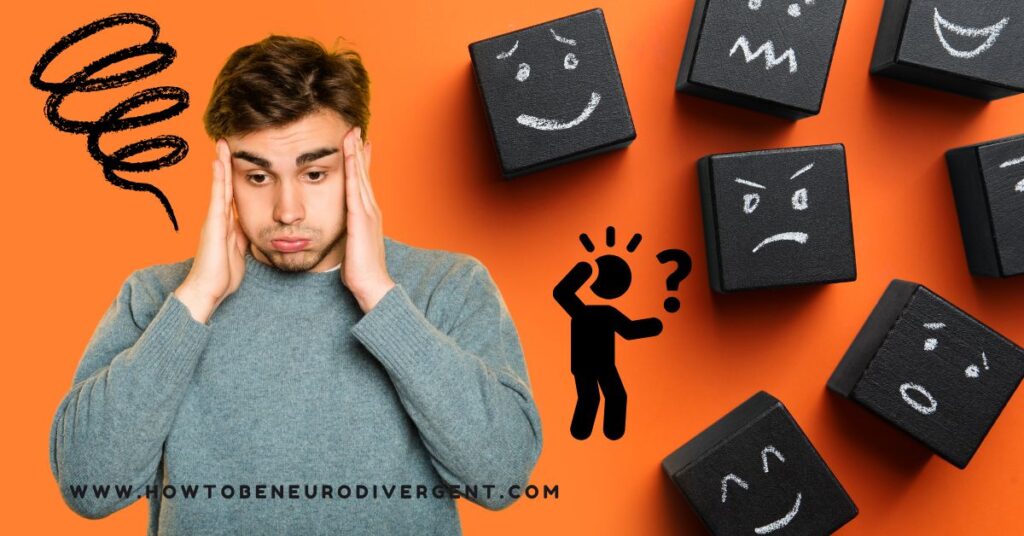


If you’ve ever said things like “I know something is wrong, but I don’t know what I’m feeling,” or “I feel overwhelmed, but I can’t tell you why,” you’re not alone.
Many late-diagnosed autistic and ADHD adults eventually discover a word for this experience: alexithymia.
Alexithymia in autistic and ADHD adults is far more common than most people realize. This is especially true for those of us who grew up undiagnosed, masking, and trying to survive in a world that didn’t give us the language (or safety) to understand our inner experience.
This isn’t a personal failure. It’s a nervous system and development story.
Let’s talk about what alexithymia actually is, how it shows up in late-diagnosed neurodivergent adults, and (most importantly) how self-compassion can become part of healing your relationship with your emotions.
Table of Contents
ToggleWhat is Alexithymia?
Alexithymia is a term used to describe difficulty:
- Identifying emotions
- Describing emotions to others
- Distinguishing between emotions and physical sensations
- Accessing emotional language in real time
Alexithymia is not a mental health diagnosis. It’s a trait. And it shows up at significantly higher rates in autistic and AHDH adults than in the general population.
When we talk about alexithymia in autistic and ADHD adults, we’re talking about a difference in emotional processing, not a lack of emotions.
You still feel deeply. You just may not be able to name what’s happening inside.
Why Alexithymia Is So Common in Late-Diagnosed Autistic and ADHD Adults
For many late-diagnosed adults, alexithymia didn’t appear out of nowhere. It developed in context. Here are a few reasons alexithymia is especially common in late-diagnosed autistic and ADHD adults:
1. Emotional Language Wasn't Modeled or Reinforced
If you were frequently told you were:
- Overreacting
- Too sensitive
- Dramatic
- Confusing
- Hard to understand
…you may have learned to disconnect from your emotions rather than explore them.
2. Masking Took Priority Over Self-Awareness
Many neurodivergent adults learned early on that fitting in mattered more than understanding themselves.
Masking teaches you to monitor others constantly (often at the expense of noticing what you feel).
Over time, that outward focus can make internal awareness feel unfamiliar or unsafe.
3. Nervous System Overload Blurs Emotional Signals
Autism and ADHD both involve differences in sensory processing and nervous system regulation. When your system is frequently overwhelmed, emotions can register as:
- Physical discomfort
- Irritability
- Shutdown
- Exhaustion
Instead of clear emotional signals, everything blends into “too much.”
What Alexithymia Can Look Like in Adult Relationships
Alexithymia in autistic and ADHD adults often becomes most noticeable in close relationships. You might:
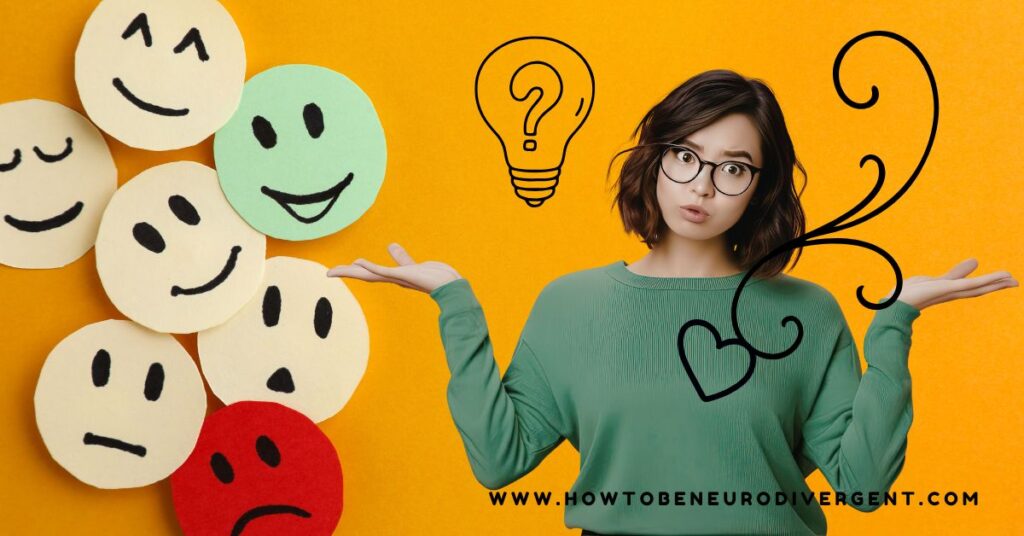
- Struggle to answer “How do you feel?”
- Freeze during emotional conversations
- Feel frustrated when asked to process feelings out loud
- Realize how you feel hours or days later
- Experience conflict without knowing what triggered it
This can lead to misunderstandings. It’s not because you don’t care, but because your internal experience isn’t easily accessible in the moment.
And for many late-diagnosed adults, this becomes a source of shame.
Alexithymia Is Not Emotional Immaturity or Avoidance
This is important enough to say clearly:
Alexithymia is not the same thing as emotional immaturity, emotional unavailability, or avoidance.
Those labels often get unfairly placed on autistic and ADHD adults. Especially in relationship advice spaces that aren’t neuro-affirming.
Alexithymia is about access, not about how much effort you’re putting in.
You are not withholding emotions. You are translating them. And translation takes time.
Self-Compassion When You Can't Name Your Feelings
Many late-diagnosed adults respond to alexithymia with self-criticism:
- “I should be better at this.”
- “Why can’t I just explain how I feel?”
- “I’m bad at relationships.”
But self-compassion begins with understanding what your nervous system has learned to do to keep you safe.
Instead of demanding clarity, try offering curiosity.
Here are a few gentler reframes:
- “It makes sense that this is hard.”
- “My emotions are real, even if they’re unclear.”
- “I’m allowed to need time.”
Self-compassion doesn’t mean giving up on growth. It means choosing growth without shame.
Practical Ways to Support Alexithymia in Autistic and ADHD Adults
You don’t need to force emotional insight. You can build it gradually, in ways that respect your neurodivergent brain.
1. Start With Body Sensations
Instead of asking “What am I feeling?” try:
- “Where do I feel this in my body?”
- “Is this heavy, tight, buzzy, flat, or restless?”
Physical awareness often comes before emotional language.
2. Use Emotion Lists or Wheels
It’s not that you don’t have a broad emotional vocabulary or understand the definitions of various emotions. It’s identifying them in yourself during an emotionally heightened moment that can be difficult. Having words available before you need them reduces pressure.
Using tools is not cheating. It’s a way for you to scaffold access to your emotional experience.
3. Allow Delayed Processing
You’re allowed to say:
“I don’t know how I feel yet, but I will later.”
This is honest self-awareness. Trying to guess or rush your feelings won’t do anybody any good.
4. Communicate the Process, Not Just the Emotion
In relationships, it can help to explain how your emotions work:
“It takes me time to understand what I’m feeling, but that doesn’t mean it doesn’t matter to me.”
That clarity builds connection. Even before emotional clarity does.
You Are Not Broken. You Are Learning a Language Late.
Alexithymia in autistic and ADHD adults is best understood as a language delay, not an emotional deficit.
Many late-diagnosed neurodivergent adults are learning emotional vocabulary in adulthood. In the past you might have pushed away emotions or used logic and intellectualizing to “figure out” what you might be feeling. Taking this step towards personal growth takes courage. It might be the first time you’ve been able to experience big emotions without shame or punishment.
Self-compassion is not something you earn after you figure out your feelings. It’s something you deserve while you’re learning.
A Gentle Invitation
At howtobeneurodivergent.com, we believe emotional clarity grows best in safety. If this post resonated with you, you’re not alone. You’re becoming fluent in yourself, one word at a time.
I believe it’s important to feel a sense of connection, community, and support while learning to adapt after a late-diagnosis.
That’s why I created How to Be ND, my twice-monthly newsletter.
It’s a slow, thoughtful space for neurodivergent adults who are tired of hustle-based advice and one-size-fits-all solutions. Inside you’ll find gentle reflections, practical support, and reminders that you’re not broken. You’re learning how to live with clarity and self-trust.
If you’d like those notes to land in your inbox a couple of times a month (no noise, no pressure, no fixing), I’d love to have you join us.
👇Sign up for How to Be ND and let’s keep figuring this out together.
If you enjoyed this post, you might like this one 👉Rewriting Your Story as a Late-Diagnosed Neurodivergent Adult
Thanks for listening, friends.

Disclaimer:
This post reflects my personal experiences and perspectives as a late-identified neurodivergent adult. While I aim to share helpful insights, I don’t speak on behalf of the entire ADHD or autistic community. Neurodivergence is diverse and individual—please interpret this content through the lens of your own needs and experiences. This article is not a substitute for professional or medical advice.